HDC-100
Digital Chart
Optimal Digital Chart for Efficient Vision Testing
- Precise Diagnostics with a Variety of Test Charts
- Optimized Testing Environment with Convenient Settings
- Enhanced Testing Efficiency with User-Centered Convenience
MENU
Explore Details
Accurate Vision Measurement Achieved Through Diverse Test Charts
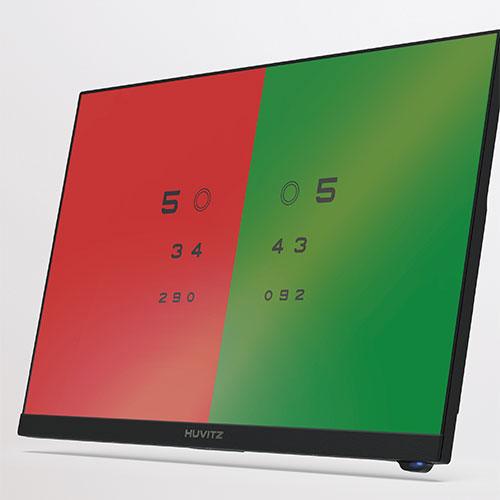
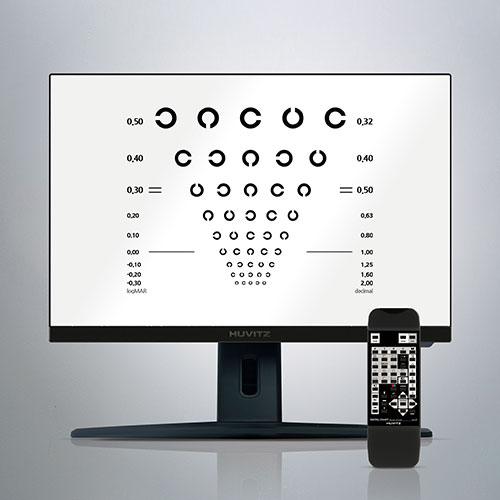
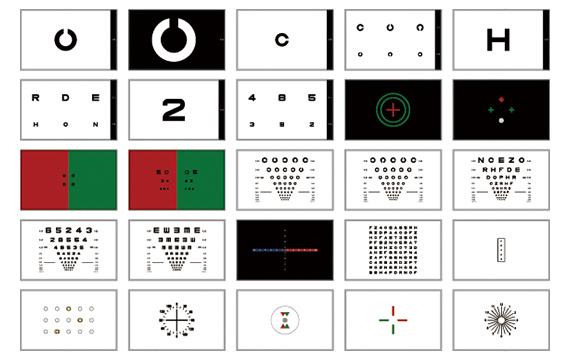
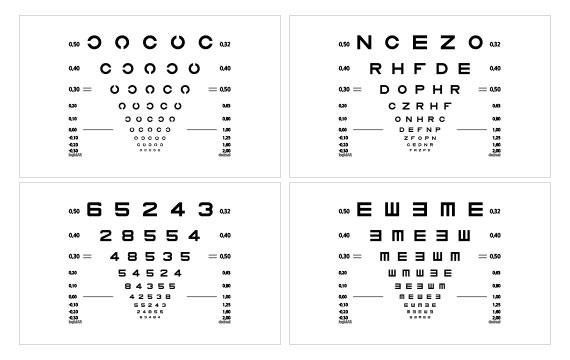
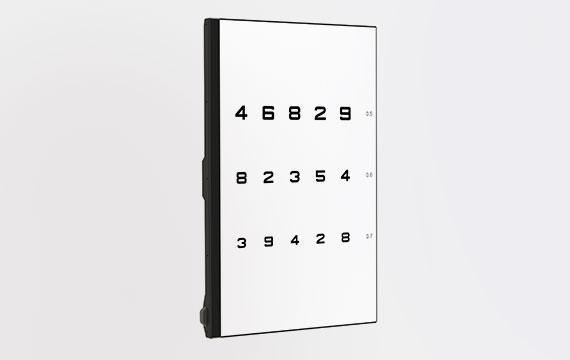
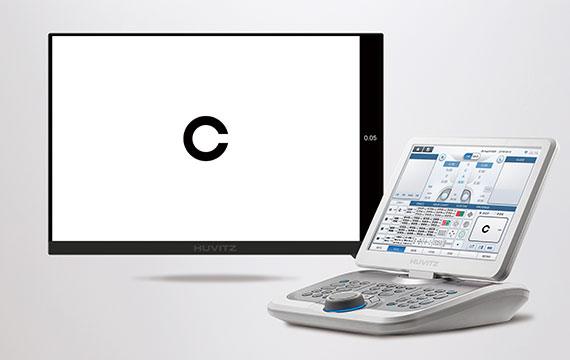
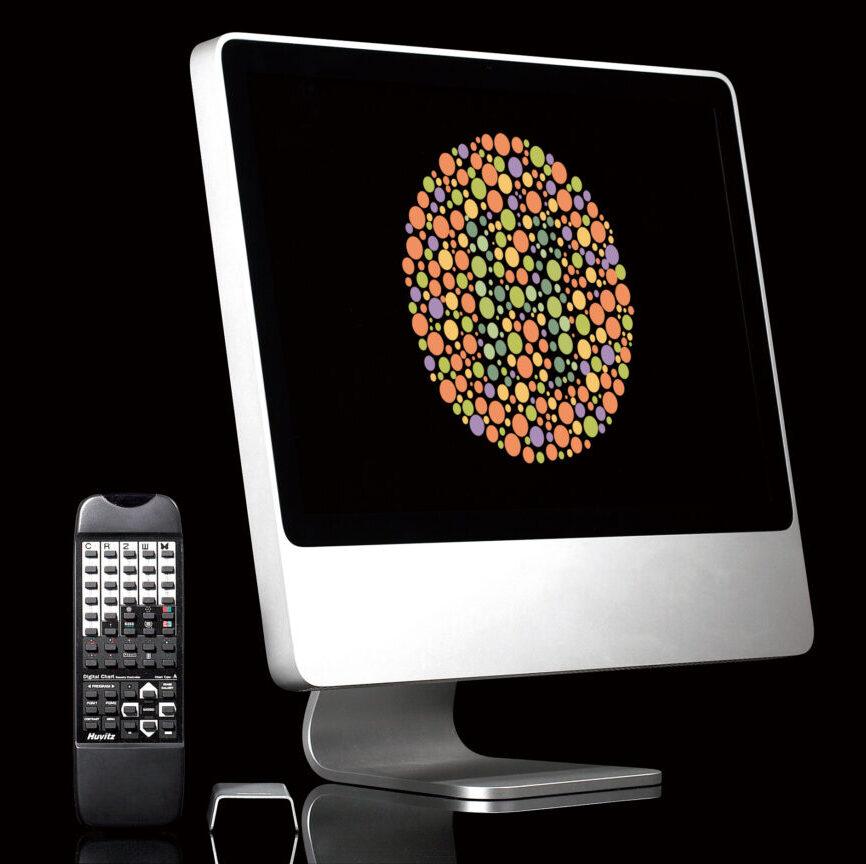
Offering more than 100 types of charts, the HDC-100 supports a wide range of methods for precise vision and visual function testing. It provides English, numeric, Landolt ring, and Snellen charts, as well as picture charts for children.


Adjustable Testing Distance and Vertical Screen Mode
The testing distance can be easily set from 1.5 m to 8 m in 0.1 m increments, allowing flexible vision testing in various environments. Both horizontal and vertical screen modes are supported, making it adaptable to different spaces and usage conditions.
Integration with Huvitz Refractors
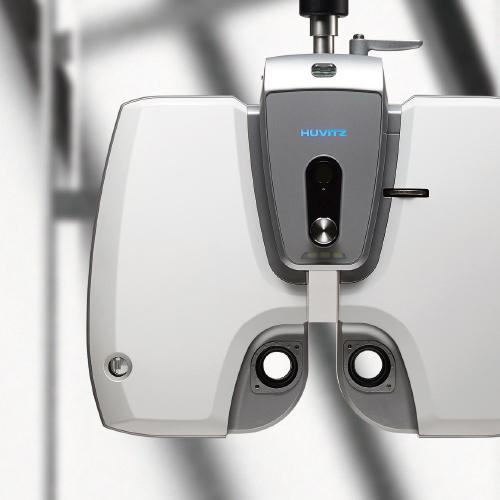
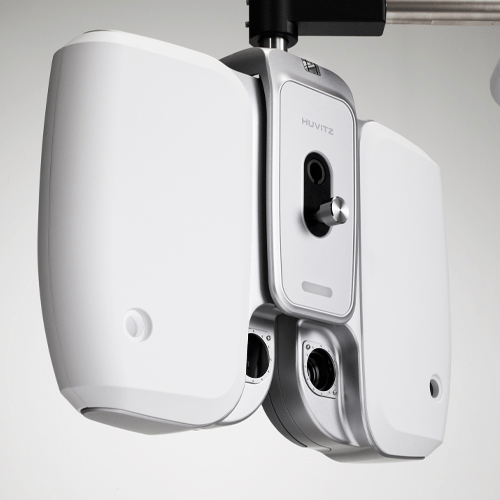
When connected to Huvitz digital refractors (HDR‑9000, HDR‑7100P), the HDC‑100 can be controlled directly from the refractor’s control panel, enabling a fast and convenient workflow for vision testing.

Specifications
1. Hardware Specification
Screen
24 inch (61.1 cm) WUXGA TFT LCD
Visible area
(W)518.4×(H)324.0 mm
Screen ratio
16:10
Resolution
1920×1200 pixels
Brightness
Max. 300 cd/㎡
Refraction distance
1.5~8.0m (0.1m step) / 4.75 ~26.00 feet (0.25 feet step)
Main processor
Amlogic S905 SoC 4 × ARM Cortex-A53 1.5GHz
64bit ARMv8 Architecture @28nm / 3×ARM Mali-450 MP 700MHz
Internal memory
MicroSD 16GB 90MB/s
Power
DC 12V 5A
Power consumption
55W
Control
Infrared radiation or serial communication of RS-232
External interface
4x USB, 1x RS-232, 1x Ethernet (10/100/1000)
Dimension and weight
(W)534×(H)361×(D)41 mm, approximately 4.0 kg
2. Software Specification
Operating System (OS)
Google’s Android
Multi-channel
Max. 4 channels
3. Optional
Standard accessory
IR Remote-control, Wall-mount bracket
Optional accessory
Floor stand, Red/Green glass
* Specification and design are subject to change without notice.
FAQ
Q. What types of vision test charts does the HDC-100 offer?
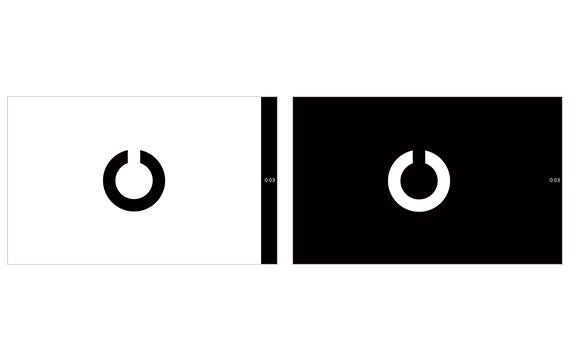
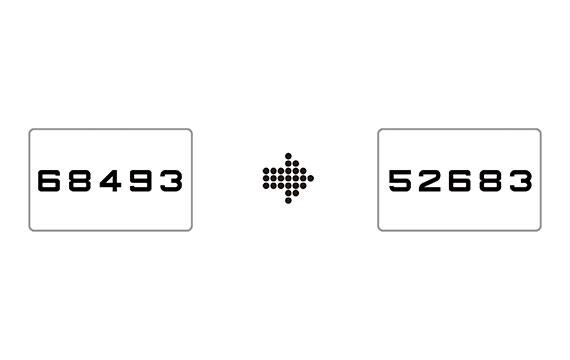
A. The HDC-100 is a digital chart that provides more than 100 different charts, supporting a wide range of visual acuity and visual function examinations. It offers charts for low-vision patients, for whom accurate measurement is difficult with standard optotypes, a random display function to prevent chart memorization, and standardized ETDRS visual acuity charts for different testing distances. This broad selection enables accurate results across various examination environments.
Q. How is the testing distance of the HDC-100 adjusted?
A. The HDC-100 allows the visual acuity testing distance to be easily adjusted from 1.5 m to 8 m in 0.1 m increments, enabling flexible use in diverse examination settings. It also supports both landscape and portrait display modes, allowing efficient operation even in confined spaces or special layouts.
Q. Can it be integrated with Huvitz digital refractors?
A. Yes. The HDC-100 can be integrated with Huvitz digital refractors such as the HDR-9000 and HDR-7100P. The chart can be controlled directly from the refractor’s control panel, streamlining examination workflow and creating a more efficient optometry environment.
Q. What are the main user convenience features of the HDC-100?
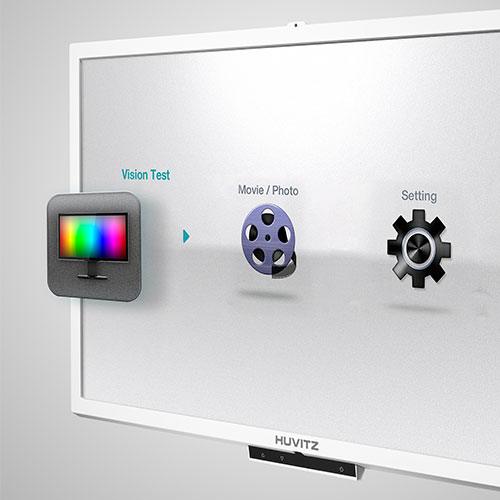
A. The HDC-100 offers adjustable testing distances from 1.5 m to 8 m in 0.1 m steps and supports both horizontal and vertical screen modes for flexible use in various spaces. It can also be linked with Huvitz digital refractors, including the HDR-9000 and HDR-7100P, allowing charts to be controlled from the refractor control panel for smoother examination flow. In addition, it provides example images and video playback functions to help explain refractive errors, enhancing usability during examination guidance and patient consultation.
Q. What kind of examination environment is the HDC-100 suitable for?
A. The HDC-100 is suitable for a wide range of vision testing environments, including ophthalmology clinics, optical shops, and optometry rooms. With freely adjustable testing distances and support for both landscape and portrait display modes, it can be used flexibly even in limited spaces. Its diverse chart configurations support examinations ranging from standard visual acuity tests to visual function assessments, making it well suited to various clinical environments.